Contact information
Websites
- Github
- Google scholar
-
Using T-Cell signals to detect and track gliomas
The Brain Tumour Charity
Team
Open to approach for:
- Potential DPhil projects
- Clinical Academic Trainees
- MSc/FSH student projects
- Visiting students/fellows
Current team:
Aleema Iqbal, CRUK DPhil candidate, University of Oxford
Aleema is a CRUK funded DPhil candidate working on identifying immune biomarkers of disease progression/relapse in adult diffuse gliomas.
Safiyah Mohamed, CRUK DPhil candidate, University of Oxford
We are delighted to welcome back Safiyah, who will be undertaking a 4-year DPhil project working on multi-modal data integration across digital pathology, genomic, metabolomic and proteomic datasets, to develop critical insights into Brain Cancer.
Visitors:
Wan Su is a postgraduate M.D. student of Endocrinology at Peking Union Medical College Hospital. She will be visiting the lab supported by a Chinese Scholarship Council fellowship.
Final Honours Students:
Hannah Sandhu is currently undertaking her Final Honours research project within the group, focusing on the role of mechanosensing proteins in driving glioma invasion.
Enqing Swea is also completing their Final Honours research project within the group, developing a glioma stem cell model to study cell-cell interactions within the tumour microenvironment.
Alumni:
Phoebe Baggott, MSc in Biochemistry, Hertford College, University of Oxford
Phoebe was co-supervised with Prof Rachael Bashford-Rogers, and worked on developing a novel high-throughput Adaptive Immune Receptor Repertoire (AIRR) sequencing platform.
Safiyah Mohamed, MSc in Biomedical Sciences, University of Amsterdam
Safiyah joined as a Master's student, conducting a meta-analysis of the transcriptomic landscape of the immune microenvironment in adult diffuse gliomas. She successfully completed her MSc and will be rejoining the lab in 2025 as a DPhil student
Bo Sun
MBBS DPhil MRCP
The Brain Tumour Charity Future Leaders Fellow
- NIHR Academic Clinical Lecturer in Neurology
- Honorary Neurology Specialty Registrar
- Neurology Registrar Coordinator for Thames Valley Deanery
- ABNT Representative for Thames Valley Deanery
Our research
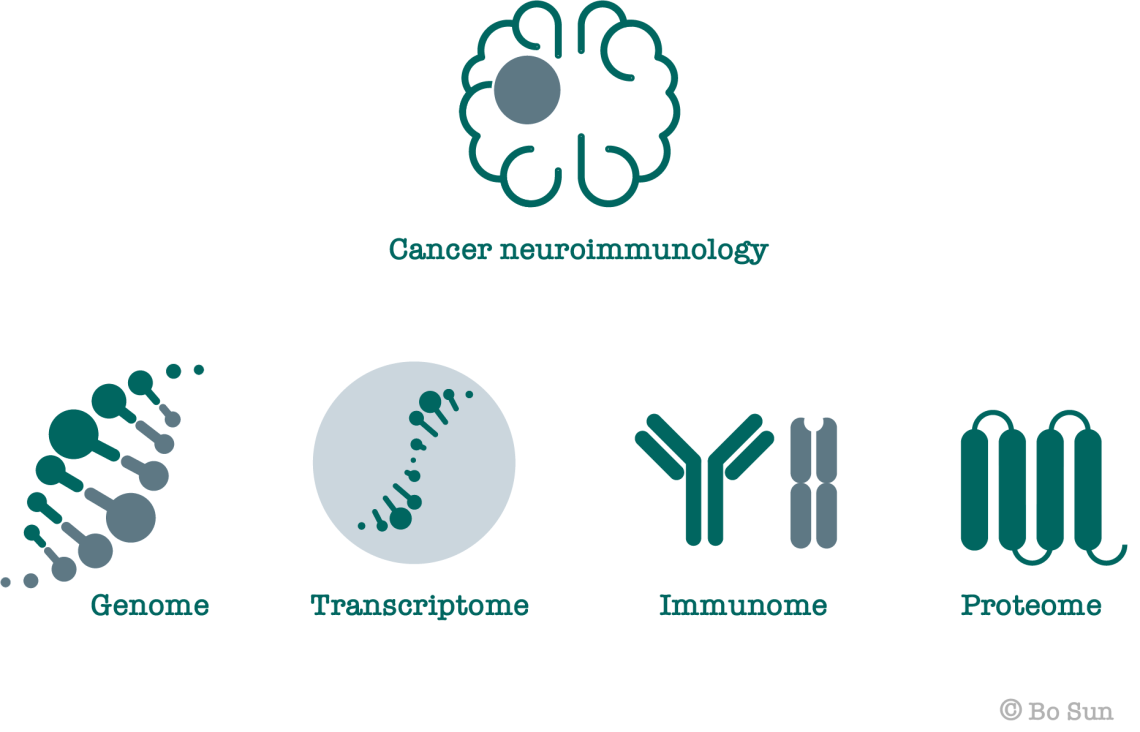
The adaptive immune system is responsible for recognising and eliminating foreign pathogens while maintaining self-tolerance to prevent autoimmunity. However, in some cases, the immune system fails to recognise self-antigens, leading to autoimmune diseases. On the other hand, cancer cells can evade immune surveillance by developing mechanisms to avoid detection by the immune system. Therefore, by studying the interplay between the immune system, autoimmune diseases, and cancer, we can gain insights into the mechanisms that lead to these diseases.
To address these questions, we are using a variety of techniques such as whole genome sequencing, adaptive immune receptor repertoire sequencing, single-cell/bulk RNA sequencing, and in vitro cellular models. By analysing large multimodal datasets, we hope to identify novel targets for therapeutic intervention and develop approaches for early cancer detection with the aim towards better personalised treatment strategies for patients.
Biography
I am an NIHR Academic Clinical Lecturer in Neurology, and my research interests are focused on understanding the underlying mechanisms of autoimmune/inflammatory diseases of the central nervous system and brain cancer. Specifically, I am interested in studying the role of the adaptive immune system and how immune tolerance to self can be modelled using the dichotomous nature of autoimmunity versus cancer.
I have previously undertaken my DPhil across the Oxford Autoimmune Neurology group and the Bashford-Rogers group, where I explored the role of immune tolerance in CASPR2-antibody encephalitis and SARs-CoV-2 infection. My aim is to translate my findings to wider states of Neuro-immunological dysfunction, with a view to identify new targets for immunomodulation and better treatment strategies.
Collaborators
-
Olaf Ansorge
Associate Professor
-
Patrick Waters
Associate Professor, Co-Director Autoimmune Neurology Diagnostic Laboratory
-
Maria Isabel Leite
Associate Professor

Support Our Brain Cancer Research
Donate towards our Research in Brain Cancer
Your donation provides essential funding for our ongoing research efforts aimed at advancing the understanding and treatment of brain cancer.
Affiliated Research groups
Key publications
Basophils drive the resolution and promote wound healing in adult and aged mice
Journal article
Bex J. et al, (2026), Journal of Experimental Medicine, 223
Protecting lactoferrin for iron delivery: Effects of matrix composition and iron loading on gastric stability
Journal article
Blanco-Doval A. et al, (2026), Food Hydrocolloids, 174
Characterization of ferroportin disease and SLC40A1-related hemochromatosis - Results from the EASL non-HFE registry.
Journal article
Troppmair MR. et al, (2026), J Hepatol, 84, 728 - 737
Single-cell analysis of signalling and transcriptional responses to type I interferons
Journal article
Rigby RE. et al, (2026), EMBO Reports
Metabolite-induced DNA damage drives stochastic stem cell loss and clonal hematopoiesis.
Journal article
Kamimae-Lanning AN. et al, (2026), Cell Stem Cell
International testing and refinement of AI algorithms predicting acute leukemia subtypes from routine laboratory data.
Journal article
Turki AT. et al, (2026), Nat Commun, 17
The 9th International RASopathies Symposium.
Journal article
Castel P. et al, (2026), Am J Med Genet A
A functional overlap between actively transcribed genes and chromatin insulator elements.
Journal article
Cornell LJ. et al, (2026), EMBO J
Gain and Loss of FLT3 Mutations in Patients with Acute Myeloid Leukemia: A Noninterventional Cohort Study (CLEVO).
Journal article
Papayannidis C. et al, (2026), Oncol Ther
Protocol for stable cell line production to express muscle-type nicotinic receptor.
Journal article
Li A. et al, (2026), STAR Protoc, 7
A mechanism to initiate emergency type 2 myelopoiesis.
Journal article
Fagnan A. et al, (2026), Nature
Expanding the phenotypic spectrum associated with ZIC1 variants: a neurodevelopmental disorder with and without craniosynostosis
Journal article
TWIGG S., (2026), Genetics in Medicine
Single intramuscular injection of self-amplifying RNA of Nppa to treat myocardial infarction.
Journal article
Zhang K. et al, (2026), Science, 391
RLevolution: Unravelling the history of genomic instability through deep reinforcement learning
Journal article
AHMED A., (2026), Royal Society Open Science
Engineering bone-marrow in a dish - a bloody business: Pre-clinical opportunities, translational use-cases, and a call for consensus.
Journal article
North D. et al, (2026), J Thromb Haemost
Artificial Intelligence Mole-Mapping Surveillance Technologies for Clinicians: A Scoping Review (Preprint)
Preprint
Ibrahim H. et al, (2026)
The vital role of p97/valosin-containing protein-mediated degradation pathways in tumour immunity.
Journal article
Phyu SM. et al, (2026), Curr Opin Cell Biol, 99
BCR::ABL1-Induced Enhancer Reprogramming Uncovers Hypersensitivity of Ph+B-ALL Cells to Enhancer-Targeting Drugs.
Journal article
Ng HL. et al, (2026), Adv Sci (Weinh)
Acute generalised exanthematous pustulosis in a patient on pembrolizumab for palliative treatment of lung adenocarcinoma.
Journal article
Ibude EA. et al, (2026), Clinical and experimental dermatology
Context-specific regulatory genetic variation in MTOR dampens neutrophil-T cell crosstalk in pneumonia-associated sepsis.
Journal article
Zhang P. et al, (2026), Nat Commun
comBO: A combined human bone and lympho-myeloid bone marrow organoid for preclinical modeling of hematopoietic disorders.
Journal article
Shen Y. et al, (2026), Cell Stem Cell
FACT safeguards promoter topology by maintaining nucleosomes and restricting chromatin factor spreading
Preprint
Dopico-Fernandez AM. et al, (2026)
Integrative multi-omics defines melanoma drug response networks and ARID1A-dependent resistance mechanisms.
Journal article
Barker CG. et al, (2026), Mol Syst Biol
Facilitators may represent a new class of regulatory elements.
Journal article
Kassouf M. et al, (2026), Curr Opin Genet Dev, 97
Signalome-wide mapping of the NFκB pathway in T-cells reveals novel targets for immunotherapy
Preprint
Clarke J. et al, (2026)
ATRX loss couples genome instability at a G-rich repeat to dysregulation of human alpha-globin expression.
Journal article
Shen Y. et al, (2026), Nat Commun
High-throughput monoclonal gammopathy community monitoring programme.
Journal article
Agarwal G. et al, (2026), Br J Haematol
PAXIS: A Randomized, Double-Blind, Placebo-Controlled, Dose-Finding Phase 2 Study (Part 1) Followed by an Open-Label Period (Part 2) to Assess the Efficacy and Safety of Pacritinib in Patients with VEXAS Syndrome.
Journal article
Beck DB. et al, (2026), J Clin Med, 15
Prognostic impact of myelodysplasia-related gene mutations in FLT3-ITD-mutated acute myeloid leukemia.
Journal article
Mecklenbrauck R. et al, (2026), Leukemia
Switching and Sniffing around the β-globin cluster.
Journal article
Higgs D. and Gupta K., (2026), Blood, 147, 609 - 610
Rapid clonal selection within early hematopoietic cell compartments presages the outcome of ivosidenib combination therapy.
Journal article
Turkalj S. et al, (2026), Blood, 147, 613 - 632
Congenital myasthenic syndrome: is it time for a name change to genetic myasthenic syndrome?
Journal article
Ramdas S. et al, (2026), Brain
Molecular-level observation of the self-assembly of a virus-like particle
Preprint
Asor R. et al, (2026)
JAK2V617F reprograms Hypoxia Inducible Factor-1 to induce a non-canonical hypoxia regulon in myeloproliferative neoplasms.
Journal article
Kealy D. et al, (2026), Leukemia
Development of a GC-MS/MS method to quantify 120 gut microbiota-derived metabolites.
Journal article
Denisov N. et al, (2026), Anal Bioanal Chem, 418, 1035 - 1054
Investigation and management of thrombocytosis without JAK2, CALR or MPL mutations: A British Society for Haematology Guideline.
Journal article
Godfrey AL. et al, (2026), Br J Haematol, 208, 471 - 485
Precancerous microenvironment: A signalling perspective.
Journal article
Qin X., (2026), Curr Opin Cell Biol, 98
Correction: Tracking early mammalian organogenesis - prediction and validation of differentiation trajectories at whole organism scale.
Journal article
Imaz-Rosshandler I. et al, (2026), Development (Cambridge, England), 153
Quantitative analysis of underivatised short-chain fatty acids and simultaneous non-targeted metabolic profiling by ultra-high performance liquid chromatography-mass spectrometry
Journal article
Neef SK. et al, (2026), Microchemical Journal, 221
Menin inhibitors: a 2-in-1 defense versus AML immune evasion.
Journal article
Chakraverty R., (2026), Blood, 147, 482 - 483
Characteristics of humoral and T-cell immune responses in people living with HIV after breakthrough SARS-CoV-2 Omicron variant infection during December 2022 to January 2023.
Journal article
Ding H-B. et al, (2026), Virol Sin
Correction to "DNA-Programmable Protein Degradation: Dynamic Control of Proteolysis-Targeting Chimera Activity via DNA Hybridization and Strand Displacement".
Journal article
Kashyap D. et al, (2026), JACS Au, 6, 653 - 655
Chromosomal Rearrangements Identified in Three Additional Patients With Generalized Congenital Hypertrichosis With Gingival Hyperplasia Involving the 17q24.2-q24.3 Locus.
Journal article
Tenorio-Castano J. et al, (2026), Clin Genet
Using Patient Feedback to Improve Treatment Outcomes for Patients with Congenital Dyserythropoietic Anaemia Type I Receiving Interferon Therapy.
Journal article
Frey K. et al, (2026), J Clin Med, 15
Linking interpersonal differences in gut microbiota composition and drug biotransformation activity.
Journal article
Mastrorilli E. et al, (2026), bioRxiv
Menin maintains enhancer-promoter interactions in a leukemia-specific manner
Preprint
Sharlandjieva V. et al, (2026)
Fine-tuning BACH2 dosage balances stemness and effector function to enhance antitumor T cell therapy.
Journal article
Conti AG. et al, (2026), Nat Immunol
Nucleotide metabolic rewiring enables NLRP3 inflammasome hyperactivation in obesity.
Journal article
Liu D. et al, (2026), Science, 391
Assessment of Clinician- and Patient-Reported Outcomes After Mohs Micrographic Surgery.
Journal article
Vetsiou E. et al, (2026), Dermatol Surg
Unravelling co-mutational patterns with prognostic implications in NPM1 mutated adult acute myeloid leukemia - a HARMONY study.
Journal article
Hernández-Sánchez A. et al, (2026), Leukemia
Off-the-shelf dual CAR-iNKT cell immunotherapy eradicates medullary and leptomeningeal high-risk KMT2A-rearranged leukemia.
Journal article
Ren H. et al, (2026), Blood, 147, 180 - 196
CAR-T cells in the treatment of neurological autoimmune diseases.
Journal article
Vonberg FW. et al, (2026), Pract Neurol
Oxford Classic-Defined EMT Risk Stratification of High-Grade Serous Ovarian Cancer for Guiding Treatment Decisions.
Journal article
Rai L. et al, (2026), Clin Cancer Res, 32, 188 - 202
Recent publications
CAR-T cells in the treatment of neurological autoimmune diseases.
Journal article
Vonberg FW. et al, (2026), Pract Neurol
Stem-like CD8+ T cells preserve HBV-specific responses in HBV/HIV co-infection.
Journal article
Preechanukul A. et al, (2025), Gut
Defining the genetic determinants of CD8+ T cell receptor repertoire in the context of immune checkpoint blockade.
Journal article
Ng ES. et al, (2025), Sci Adv, 11
CMV serostatus is associated with improved survival and delayed toxicity onset following anti-PD-1 checkpoint blockade.
Journal article
Milotay G. et al, (2025), Nat Med, 31, 2350 - 2364
Advancing atmospheric solids analysis probe mass spectrometry applications: a multifaceted approach to optimising clinical data set generation.
Journal article
Song L. et al, (2025), Analyst, 150, 2620 - 2631
Validation of the "Patient-Acceptable Symptom State" Question as Outcome Measure in AChR Myasthenia Gravis: A Multicentre, Prospective Study.
Journal article
Spagni G. et al, (2025), Eur J Neurol, 32